••
Ghana and UK Launch Landmark £215 Million Growth Partnership to Drive Industrial 'Reset' and Job Creation
•3 min read•24 sources
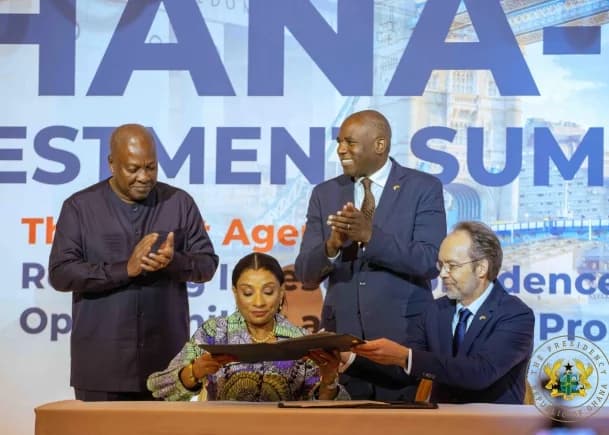
President John Dramani Mahama and UK Deputy Prime Minister David Lammy have formalized a landmark £215 million 'UK-Ghana Growth Partnership' at the Ghana-UK Investment Summit 2026 in London. This agreement signals a fundamental shift from traditional foreign aid to a trade-centric economic relationship, aiming to stimulate private sector investment between 2026 and 2028. Under the banner of a 'Reset Agenda,' the summit showcased Ghana as a resilient, $100 billion economy that is emerging stronger from recent global crises. The partnership prioritizes industrial expansion, infrastructure development, and climate-smart growth to foster shared prosperity and position Ghana as a primary gateway for UK businesses entering the African market.
Central to the new agreement is the £101 million Takoradi Floating Dock Project, which will establish West Africa’s first commercial-scale ship repair and dry-docking facility. This initiative is expected to create 430 direct jobs—with a commitment to allot 30% of positions to women—while reducing the region's reliance on foreign maritime facilities. Environmental sustainability is also a core pillar, with an £85 million reforestation fund targeted at restoring degraded forest reserves in the Oti Region. Furthermore, the partnership earmarks £6 million for Ghana’s Artificial Intelligence Strategy and £4 million for specialist clinical engineering training, ensuring that the nation's youth are equipped with high-tech skills for the global economy.
While the investment outlook is bullish, Bank of Ghana Governor Dr. Johnson Pandit Asiama provided a measured perspective on domestic monetary policy. He noted that ongoing geopolitical tensions in the Middle East have delayed the central bank's ability to reach single-digit interest rates due to the resulting volatility in global energy prices and shipping costs. Despite these external shocks, Dr. Asiama and Finance Minister Dr. Cassiel Ato Forson emphasized that Ghana’s macroeconomic indicators are on a positive trajectory, citing a GDP growth rate of 6% in 2025 and improved debt sustainability. They assured the international community that fiscal discipline and new amendments to the Bank of Ghana Act will safeguard investor interests and maintain long-term price stability.
In a significant move toward financial independence, the Ghana Cocoa Board (COCOBOD) announced a transition to a locally financed funding model. Deputy CEO Ato Boateng revealed plans to raise $1 billion through a commercial paper program targeting domestic pension funds and commercial banks, thereby ending the decade-long reliance on offshore syndicated loans. Simultaneously, Energy Minister Dr. John Abdulai Jinapor presented the 'Reset Agenda' for the energy sector, highlighting opportunities in renewable energy and green transition technologies. These sectoral reforms are designed to increase the manufacturing sector's contribution to 10% of GDP by 2025, driven by an 11% increase in bilateral trade with the UK, which has already reached a record $1.5 billion.
Ultimately, the Ghana-UK Investment Summit 2026 serves as a catalyst for a more predictable and transparent investment climate. By aligning state policy with private capital and focusing on high-growth areas like agro-industry and green technology, the Ghanaian government aims to foster an environment where small and medium enterprises (SMEs) can thrive alongside multinational corporations. As the partnership moves into its implementation phase, the focus remains on transforming diplomatic ties into impactful commercial ventures that provide sustainable employment and reinforce Ghana’s status as a competitive hub for international trade and innovation.
Live rates
Bank of Ghana policy rate →

