••
Foreign Minister Ablakwa Secures Historic Russia Agreements as 62 Ghanaians Confirmed Dead in Ukraine Conflict
•3 min read•11 sources
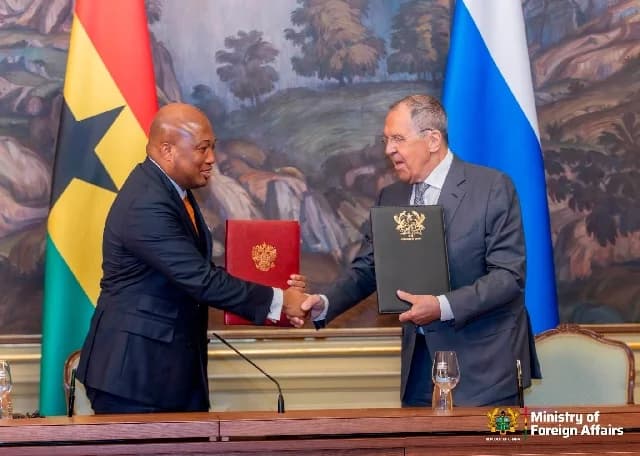
Ghana’s Foreign Minister, Samuel Okudzeto Ablakwa, has concluded a high-stakes diplomatic mission to Moscow, resulting in the first visa waiver agreement between the two nations since 1958. During meetings with Russian Foreign Minister Sergey Lavrov held between August 16 and 19, 2026, the two countries signed a historic agreement for holders of diplomatic and service passports. Beyond administrative ties, the ministers established a framework for cooperation on peace and security, specifically targeting the rising threat of terrorism and violent extremism in the Sahelian states of Burkina Faso, Mali, and Niger. While the visit aimed to bolster trade and educational exchanges, it was overshadowed by the somber confirmation of the human cost of the ongoing Russia-Ukraine war on Ghanaian families.
Minister Ablakwa disclosed the tragic news that 62 Ghanaian citizens have been confirmed dead and 15 remain missing after traveling to Russia during the conflict. Addressing the media in Moscow, Ablakwa highlighted the grave issue of illegal recruitment, where Ghanaian youth are often lured with promises of lucrative employment only to be funneled into military operations. The Russian government has pledged to collaborate with Ghanaian authorities to dismantle these illegal enlistment pipelines. Ablakwa emphasized that the Ghanaian government would continue to advocate fiercely for the safety of its nationals abroad, stating firmly that the conflict in Eastern Europe is "not our war" and should not be claiming Ghanaian lives.
On the domestic front, the administration of President John Dramani Mahama continues to prioritize the safety and reintegration of citizens caught in foreign crises. On August 17, 2026, the government successfully received the 11th batch of 87 nationals evacuated from South Africa following a wave of xenophobic attacks. This latest arrival brings the total number of returnees to approximately 1,600 since May 2026, with 300 more expected in the coming weeks. Ambassador Harold Agyeman welcomed the returnees at Accra International Airport, assuring them of resettlement packages and state support. Simultaneously, Major General Maxwell Obuba Mantey, Director-General of the Narcotics Control Commission (NACOC), called for enhanced regional collaboration and technological investment at the 2026 West Africa Border Security Week to protect Ghana’s entry points against organized crime.
These developments occur against a backdrop of heightened international and regional volatility. Moscow has recently issued stern warnings to the United Kingdom over the reported use of British-manufactured drones by Ukraine for deep strikes within Russian territory, threatening "serious consequences" for London’s escalation. Closer to home, the African continent faces multiple security challenges, including intense clashes between the Somali National Army and opposition forces for control of the city of Baidoa, and a crackdown on dissent in Mali, where a prominent influencer was recently sentenced to seven years for criticizing the military junta. Additionally, Uganda has embarked on a strategic military mission in Gaza to bolster its bid for a top United Nations seat, further illustrating the complex intersection of military power and foreign policy.
As Ghana navigates these turbulent global waters, the Mahama administration appears focused on a dual strategy of proactive diplomacy and robust citizen protection. The transition from the immediate past presidency of Nana Akufo-Addo to the current leadership has seen a renewed emphasis on direct engagement with global powers like Russia to solve both security and humanitarian concerns. Moving forward, the success of the new visa and security agreements will be measured by their ability to foster economic growth while ensuring that no more Ghanaian lives are lost to foreign conflicts or illegal recruitment schemes.


