••
Minority Leader Afenyo-Markin Demands GoldBod Probe as Government Reports 63% Drop in Financial Irregularities
•3 min read•19 sources
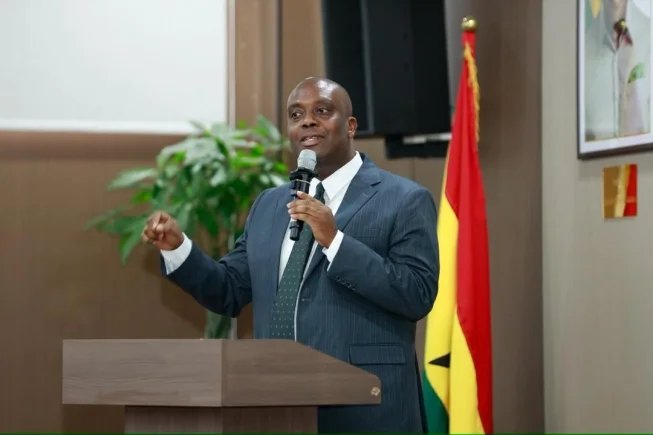
Minority Leader Alexander Afenyo-Markin has called on President John Mahama’s administration to address significant operational loopholes within the Ghana Gold Board (GoldBod) to prevent future economic losses and sustain the cedi's stability. Afenyo-Markin emphasized that transparency in gold purchasing is a national economic necessity that transcends partisan politics, impacting public sector jobs and infrastructure. The demand for scrutiny follows reports from the UK branch of the New Patriotic Party (NPP) alleging a US$1.7 billion loss under the Domestic Gold Purchase Programme (DGPP) and calling for an independent forensic audit. Meanwhile, former Minister Samuel Abu Jinapor defended the DGPP as a cornerstone of the previous administration’s economic strategy, arguing that the current Ghana Accelerated National Reserve Accumulation Policy (GANRAP) is merely a rebranding of the original initiative that successfully boosted gold reserves from 8.77 to 30.53 tonnes by late 2024.
Simultaneously, Deputy Minister for Finance Thomas Ampem Nyarko reported a major achievement in fiscal discipline, with financial irregularities across five audited sectors dropping by 62.9%. Total infractions decreased from GH₵20.72 billion in 2024 to GH₵7.69 billion in 2025, exceeding the government’s target of a 50% reduction. Nyarko attributed this improvement to strengthened public financial management and stricter internal audit enforcement. However, he noted a concerning 156.3% rise in irregularities within Ministries and Agencies, urging heads of public institutions to transition from a passive response to audit findings toward a proactive culture of accountability and prevention to protect public funds.
In the broader economic landscape, the State Interests and Governance Authority (SIGA) released its 2025 State Ownership Report, revealing that state-owned enterprises (SOEs) carry total liabilities of GH₵281.99 billion. SIGA Director-General Professor Michael Kpessa-Whyte clarified that while SIGA provides oversight, the Ministry of Finance and sector ministers remain responsible for managing the debts of loss-making entities, such as the Electricity Company of Ghana (ECG), which accounts for GH₵82.31 billion of the total liability. To further promote financial inclusion, Bank of Ghana Governor Dr. Johnson Pandit Asiama reassured the public that the new non-interest banking initiative is a commercial service designed for ethical financial growth and inclusion, rather than a tool for promoting religious doctrine.
The government also remains firm on its fiscal reforms despite industrial opposition, notably rejecting claims by Accra Brewery PLC (ABL) that changes to the beer excise duty regime would jeopardize 2,000 jobs. The Ministry of Finance asserted that ABL failed to provide evidence for its projections and noted that previous tax concessions cost the state GH₵1.75 billion in foregone revenue over three years. Other industrial developments include the Ministry of Trade's efforts to revive cotton production in the Northern Region to support local textiles, and a clarification from journalist Manasseh Azure Awuni that Northshore Apparel GH received direct support from Ghana Exim Bank rather than through the One District, One Factory (1D1F) program. These developments underscore the administration's focus on balancing industrial growth with rigorous fiscal oversight.
Related topic
NPP (New Patriotic Party): Latest News →Live rates
Ghana gold price →