••
Government Scales Up Energy Infrastructure and Industrial Support to Drive Ghana's 24-Hour Economy Initiative
•3 min read•6 sources
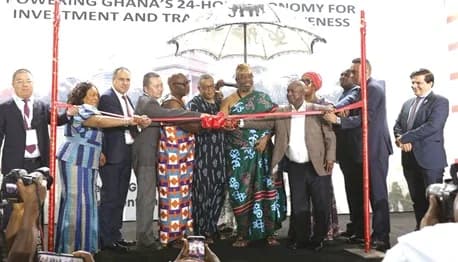
The Ghanaian government has accelerated its efforts to institutionalize a 24-hour economy by unveiling a series of strategic energy projects and industrial partnerships designed to lower operational costs and boost productivity. At the forefront of these initiatives is a massive 1.5-gigawatt solar-hydropower project at Buipe in the Savannah Region, which includes battery energy storage. This project aims to drastically reduce industrial electricity tariffs from the current 18–23 cents per kilowatt-hour to just 7–9 cents. Minister of Labour, Jobs, and Employment, Dr. Abdul-Rashid Pelpuo, revealed that over 10,000 businesses have already registered for government support under the 24-hour economy framework, seeking access to affordable electricity and expanded working capital to scale their operations.
To ensure the reliability of this transition, the Ministry of Energy and Green Transition has intensified its engagement with key private sector stakeholders. Energy Minister Dr. John Abdulai Jinapor recently met with Seth Twum-Akwaboah, CEO of the Association of Ghana Industries (AGI), to solidify a partnership aimed at fostering a more resilient energy sector. Dr. Jinapor emphasized that industry insights are crucial for shaping economic policies that support industrial expansion. Complementing this, Deputy Energy Minister Richard Gyan-Mensah, speaking at the 2026 Ghana Investment and Trade Week (GITW) Conference, underscored that dependable energy, modern infrastructure, and sustainable real estate are the three pillars required to enhance Ghana’s investment attractiveness and global competitiveness.
International cooperation is also playing a pivotal role in Ghana’s energy evolution. The Energy Commission of Ghana recently signed a Memorandum of Understanding (MoU) with the UAE-based Global South Utilities (GSU) to explore technical cooperation and investment opportunities. Signed by Acting Executive Secretary Adwoa Serwaa Bondzie and GSU CEO Ali Al Shimmari, the agreement focuses on knowledge exchange and improving infrastructure resilience to support the nation's green transition. This partnership aligns with the government's broader strategy to attract foreign direct investment into renewable energy and electric mobility solutions, ensuring that the shift to a 24-hour cycle is both economically viable and environmentally sustainable.
While long-term infrastructure is being developed, the Electricity Company of Ghana (ECG) continues to manage immediate maintenance needs to stabilize the current grid. Recent planned maintenance across the Ashanti, Accra West, Volta, and Central regions reflects the ongoing effort to upgrade service delivery amidst the transition. The convergence of these energy reforms, international partnerships, and direct business support signals a comprehensive approach to economic transformation. By lowering the cost of power and providing a stable regulatory environment, the government aims to create sustainable employment and position Ghana as a competitive industrial hub in the sub-region.


