••
KNUST-Led Consortium Secures €300,000 PharmaVax Grant to Develop Locally Manufactured Herbal Pain Relief Tablets
•2 min read•1 source
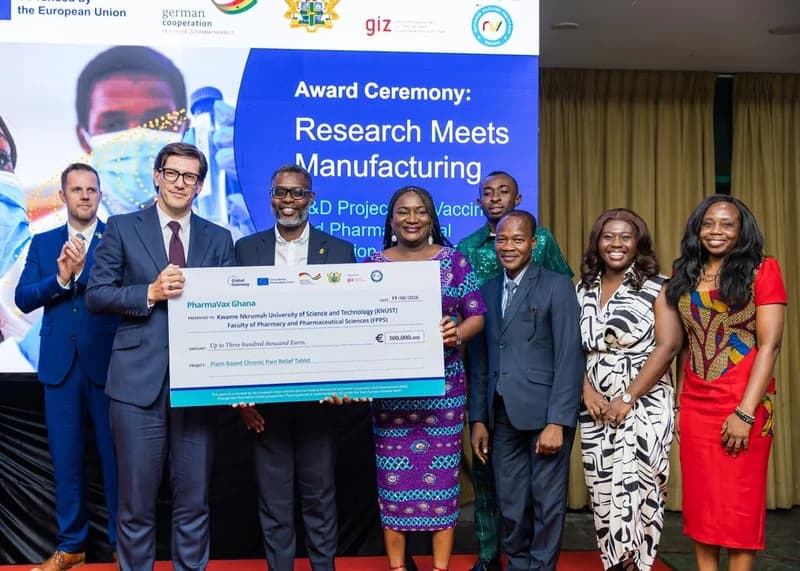
A consortium led by the Kwame Nkrumah University of Science and Technology (KNUST) has secured a €300,000 grant to develop and scale up the production of a locally manufactured herbal pain relief medicine. Awarded under the PharmaVax Ghana Programme, the initiative aims to transition a promising herbal remedy into a high-quality, sustained-release tablet formulation. The announcement, made during a ceremony on August 19, 2026, involves a strategic partnership with the National Vaccine Institute and the German development agency, GIZ, marking a significant milestone for Ghana's pharmaceutical research and manufacturing sector.
The project builds on nearly a decade of rigorous research conducted by the KNUST Faculty of Pharmacy and Pharmaceutical Sciences. A central focus of this two-year initiative is addressing the chronic challenges of raw material availability and inconsistent dosage forms that often plague the herbal medicine industry. To overcome these hurdles, researchers will employ advanced plant tissue culture techniques to ensure a steady, standardized supply of active botanical ingredients. By optimizing the delivery system into a sustained-release format, the consortium aims to provide patients with more effective and convenient treatment options compared to traditional preparations.
Success for the project hinges on a robust collaboration between academia and the private sector. The consortium includes industry leader Aspee Pharmaceuticals, which will oversee the large-scale manufacturing process, and the Biotechnology and Nuclear Agriculture Research Institute (BNARI). This synergy between KNUST’s research capabilities and Aspee’s industrial infrastructure is designed to stimulate the local pharmaceutical industry and reduce the nation's reliance on imported medicines. Experts involved in the project emphasize that beyond direct healthcare improvements, the venture is expected to create local job opportunities and strengthen Ghana's capacity for high-level pharmaceutical innovation.
The PharmaVax Ghana Programme's support underscores a broader commitment to enhancing healthcare access through domestic solutions. As the project moves into its implementation phase over the next 24 months, the successful commercialization of this herbal pain reliever could serve as a blueprint for other local remedies seeking scientific validation and industrial scaling. By bridging the gap between traditional knowledge and modern pharmaceutical science, the KNUST-led consortium aims to set a new standard for medical self-sufficiency and health security in the West African region.