••
President Mahama and African Leaders Convene in Accra to Secure Health Sovereignty and Domestic Financing
•3 min read•36 sources
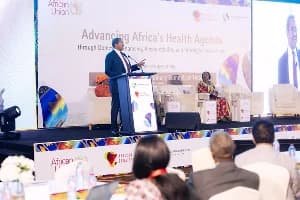
President John Dramani Mahama has opened the African Union’s Extraordinary Health Summit in Accra, calling on the continent's leaders to transition from "mere declarations" to "substantial investments" to secure Africa’s health sovereignty. The summit, held in July 2026, focuses on universal health coverage and the urgent need for domestic financing as external donor support declines. President Mahama emphasized that genuine independence requires a robust healthcare infrastructure and the local capacity to produce essential medical supplies, framing healthcare not just as a social service but as a strategic asset for national security and economic growth. He urged African leaders to turn the newly drafted Accra Declaration into measurable actions that improve maternal health and help end AIDS and tuberculosis by 2030.
The urgency of the summit is underscored by a stark warning from World Health Organization (WHO) Director-General Dr. Tedros Adhanom Ghebreyesus, who noted that Africa risks losing decades of health gains against HIV, tuberculosis, and malaria if governments do not increase domestic funding. President Mahama highlighted the severe burden of disease, noting that over 90 million Africans currently live with undiagnosed hepatitis B or C, while malaria and non-communicable diseases continue to claim millions of lives annually. To combat these challenges, the President and AU Commissioner Amma Twum-Amoah proposed the implementation of "debt-for-health" arrangements and the introduction of an annual health scorecard to hold member states accountable for their commitments to the 2001 Abuja Declaration, which pledged 15% of national budgets to healthcare.
A central theme of the discussions is the elimination of Africa’s dependence on imported medicines and vaccines. Currently, the continent imports approximately 70% of its medicines and over 99% of its vaccines, a vulnerability that was laid bare during the COVID-19 pandemic. In response, the Ghanaian government, led by Vice President Professor Jane Naana Opoku-Agyemang and Health Minister Kwabena Mintah Akandoh, announced a $50 million investment in the National Vaccine Institute to bolster local manufacturing capabilities. Stakeholders, including former Tanzanian President Jakaya Kikwete, argued that Africa’s high maternal mortality rates are a failure of implementation rather than science, urging leaders to focus on the "Accra Reset" initiative. This initiative seeks to bridge the gap between political pledges and actual service delivery through a governance structure led by current and former African presidents.
The summit also highlighted the necessity of a multi-sectoral approach to family planning and adolescent reproductive health. Dr. Sennen Hounton of the UNFPA emphasized that empowering the youth with accurate health information and economic opportunities is essential for sustainable development. As the summit concludes, leaders are expected to adopt a formal roadmap to 2030, reinforcing the commitments of the African Union. By integrating initiatives like the Ghana Medical Trust Fund (MahamaCares) and the Free Primary Healthcare Initiative into a broader continental strategy, the African Union aims to build resilient health systems capable of navigating future pandemics and ensuring health equity for all citizens across the continent.
This story touches markets covered on Anansi Intelligence ↗.
Related topic
John Mahama: Latest News & Updates →More from health
Continue exploring similar stories


