Ghana News AI
HomeBriefsAsk GhanaTopicsTools
•
•

Stay Informed

Get AI-curated news briefs from Ghana delivered to your inbox every morning. Free forever, no spam.

Explore

  • Home
  • Briefs
  • About

Categories

  • Politics
  • Business
  • Sports
  • Entertainment
  • Africa

Features

  • Analysis
  • Cedi Rates
  • Dollar to Cedi
  • Ghana Gold Price
  • BoG Policy Rate

Topics

  • Armed Forces Recruitment
  • WAEC Results & News
  • Nana Ama McBrown
  • NDC News
  • All Topics

Legal

  • Privacy Policy
  • Terms of Service
Ghana News AI© 2026. All rights reserved.
Made withfor Ghana
africa

President Mahama Welcomes Historic Visit by Archbishop of Canterbury as Pan-African Leaders Push for Women’s Rights Ratification

28th July•3 min read•6 sources
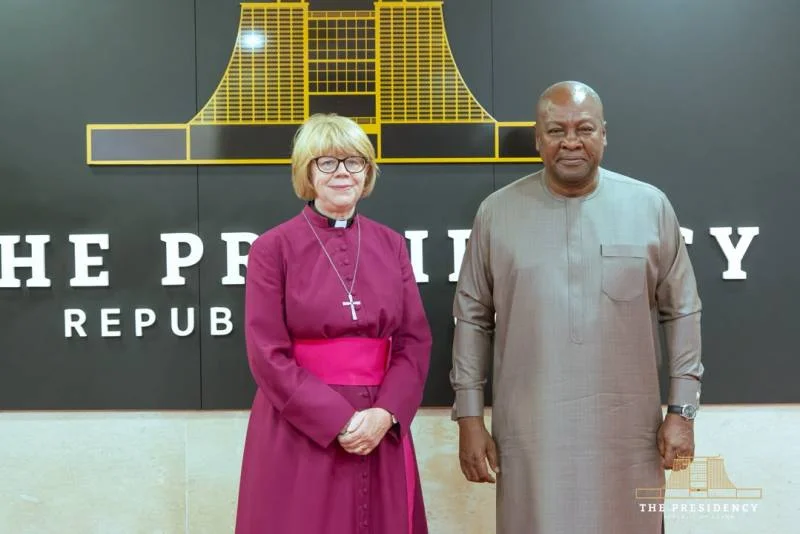
Archbishop of Canterbury pays courtesy call on President Mahama during first visit to Africa
  1. Home
  2. /Africa
  3. /President Mahama Welcomes Historic Visit by Archbishop of Canterbury as Pan-African Leaders Push for Women’s Rights Ratification

In a landmark diplomatic and religious engagement, President John Dramani Mahama received the Most Reverend Sarah Mullally, the first woman to serve as the Archbishop of Canterbury, at the Jubilee House in Accra on July 27, 2026. This inaugural visit to Africa by the Archbishop forms part of a 10-day tour across the Church of the Province of West Africa. During the meeting, President Mahama congratulated Archbishop Mullally on her historic appointment, describing it as a significant milestone for women in leadership and an inspiration for the Anglican Communion worldwide. The President also expressed his administration's gratitude for the Anglican Church’s long-standing contributions to Ghana’s development, particularly in the sectors of healthcare, education, and social services.

Central to the discussions was the announcement of the Heritage Anglican Cultural Village and Resorts project, a major initiative aimed at preserving the history of the transatlantic slave trade. Archbishop Mullally emphasized that the project is designed to foster reconciliation for the African diaspora and provide a space for reflection on shared history. Accompanied by a delegation of Ghanaian Anglican bishops and the British High Commissioner, Dr. Christian Rogg, the Archbishop’s visit is expected to further solidify the bilateral relationship between Ghana and the United Kingdom, building upon President Mahama’s recent high-level engagements with King Charles III.

The themes of women’s leadership and social justice highlighted during the Archbishop’s visit echo recent calls from the Pan-African Parliament regarding continental protections for women. Dr. Zanetor Agyeman-Rawlings, Second Vice-President of the Pan-African Parliament, has been a leading voice in Johannesburg urging African Heads of State to prioritize the ratification and implementation of the African Union (AU) Convention on Ending Violence Against Women and Girls. She stressed that strengthening legal protections is fundamental to achieving the aspirations of Agenda 2063 and ensuring that women’s rights are treated as non-negotiable human rights.

Furthering the agenda for gender equity, Dr. Agyeman-Rawlings has called for more sophisticated economic policies, including gender-responsive budgeting and the formal recognition of the economic value of women’s unpaid domestic work. She also issued a cautionary note regarding the digital divide, warning that emerging technologies such as Artificial Intelligence (AI) must be carefully managed to prevent new forms of marginalization against women and girls. These advocacy efforts at the legislative level complement the symbolic progress represented by the presence of leaders like Archbishop Mullally in traditionally male-dominated hierarchies.

As Ghana continues to navigate its role as a regional leader, the convergence of religious diplomacy and pan-African legislative advocacy points toward a future focused on social reconciliation and human rights. The government’s commitment to economic stability and social development, as reiterated by President Mahama, remains intertwined with these broader continental goals. The successful implementation of projects like the Anglican Cultural Village and the adoption of the AU Convention on Ending Violence Against Women are viewed as critical steps in fulfilling the promise of a more inclusive and prosperous Africa.

Our Take

From the Team

Coming Soon

Our team will add key insights, trends, and actionable takeaways to help you stay informed faster.

This story touches markets covered on Anansi Intelligence ↗.

Related topic

John Mahama: Latest News & Updates →

More from africa

Continue exploring similar stories

The ferry was a vital lifeline for rural villagers to the lakeside town of Kariba.  By Jekesai NJIKIZANA (AFP)
africa|17th August

Zimbabwe Ferry Tragedy Death Toll Reaches 84 as Ghanaian Worker Shares Ordeal of Abuse in Iraq

Zimbabwe is currently in a state of mourning as the death toll from a ferry capsizing on Lake Kariba has risen to 84. The incident occurred when the vessel, which was carrying 161 passengers despite a maximum capacity of only 90, encountered rough waters and overturned. Survivors have provided chilling accounts of the disaster, noting that the captain had been repeatedly warned about the dangerous conditions and the excessive weight before the tragedy struck. The ferry served as a crucial transport link for rural villagers, and the lack of alternative travel options has brought the issue of infrastructure safety to the forefront of national discourse. Recovery efforts are still ongoing as police continue to search the lake, while hundreds of family members have gathered at nearby hospitals to identify their loved ones. The disaster has prompted widespread calls for the Zimbabwean government to ensure justice for the victims and to provide compensation for the affected families. This event highlights the dire consequences of regulatory failure in the transportation sector, where overcrowding remains a frequent but lethal risk for commuters in remote areas. Parallel to this maritime tragedy, a distressing report has emerged involving a Ghanaian citizen subjected to severe human rights abuses while working in Iraq. The woman, who traveled to the Middle East in pursuit of better job opportunities, described a harrowing ordeal of repeated physical assault and extreme labor exploitation. Despite having secured her employment through an agency, she discovered that the working conditions were significantly harsher than she had been led to believe, leaving her in a vulnerable and precarious situation far from home. The victim's story reflects a broader trend of exploitation faced by West African migrants who are often lured by the promise of financial stability only to find themselves trapped in abusive environments. The discrepancy between the promises made by recruitment agencies and the reality of life in foreign labor markets remains a critical issue for Ghanaian authorities to address. Her testimony serves as a stark warning about the dangers of unregulated migration and the need for more robust protections for citizens working abroad. Both stories serve as somber reminders of the vulnerabilities faced by citizens in the pursuit of safety and economic security. While Zimbabwe grapples with the immediate aftermath of a preventable disaster on its waters, the international community is reminded of the ongoing risks to migrant workers in the global labor market. These incidents emphasize the urgent necessity for governments to strengthen safety regulations, enforce legal protections, and hold accountable those whose negligence or malice puts human lives at risk.

Daily Graphic's Timothy Ngnenbe interacting with Noah Aggrey as he mends his net at the shores of Azizape Island.
africa|17th August

Ayetoro and Azizape Communities Face Existential Threat as Rising Sea Levels Submerge West African Coastlines

Coastal communities across West Africa are grappling with an existential crisis as rising sea levels and intensified Atlantic tides systematically reclaim land and livelihoods. From the shores of Azizape in Ghana to the historic town of Ayetoro in Nigeria, the encroaching ocean has transformed once-thriving fishing hubs into zones of persistent displacement. Residents who have lived by the sea for generations now find themselves in a desperate cycle of rebuilding, only to see their homes and infrastructure swallowed by the water months or years later. In Ayetoro, a coastal town in southern Nigeria founded in 1947, the situation has reached a critical point with the community reportedly losing an average of 15 meters of its coastline annually since 1987. King Oluwambe Ojagbohunmi and his subjects describe a harrowing reality where vital social services, including schools and health centers, have been repeatedly relocated inland. Despite these efforts, the ocean continues to advance, leaving many residents feeling like refugees in their own community as the loss of land causes a total disruption of the town's historical and socioeconomic fabric. Similarly, in Ghana’s Azizape community, the environmental toll is devastating the local fishing industry and threatening the very way of life for residents like 61-year-old Noah Aggrey. The crisis significantly impacts women, who are primarily responsible for fish processing; they report that declining catch yields are undermining their economic stability. In a desperate bid for survival, some community members have turned to harvesting mangrove ecosystems for short-term income, a practice that unfortunately destroys natural barriers and exacerbates the community's vulnerability to storm surges. Experts and local leaders are calling for urgent interventions that move beyond traditional engineering solutions. While sea defense walls are often proposed, there is a growing consensus that natural solutions, such as mangrove restoration, must be integrated with infrastructure projects to combat erosion effectively. Furthermore, both communities emphasize the necessity of government support to facilitate sustainable livelihood diversification. As the Atlantic continues its inland march, the survival of West Africa’s coastal heritage depends on a coordinated response that addresses both the immediate humanitarian needs of the displaced and the long-term realities of a changing climate.

Moroccan Authorities Oversee Voluntary Return of 531 Migrants Amid Tightened Border Security
africa|17th August

Moroccan Authorities Oversee Voluntary Return of 531 Migrants Amid Tightened Border Security

On August 13, 2023, Moroccan authorities oversaw the voluntary return of 531 individuals who were identified as candidates for irregular migration near the Spanish-administered enclave of Sebta. This significant repatriation effort is part of Morocco's broader strategy to curb illegal border crossings and dismantle the sophisticated human trafficking networks operating in the North African region. The return of these individuals highlights the ongoing challenges faced by the nation as it manages the complex flow of migrants attempting to reach European territory through its northern coastal cities. In response to the persistent pressure at the borders, Moroccan security forces have significantly intensified their operations near Sebta and Melilla. These areas have long served as primary transit points for those seeking entry into Spain, prompting the government to bolster its physical presence and surveillance capabilities. Beyond increased patrols, the Ministry of the Interior has initiated legal proceedings against persons involved in facilitating unlawful migration activities, aiming to disrupt the criminal syndicates that exploit vulnerable populations for profit. The Moroccan Ministry of the Interior has emphasized that addressing the root causes and logistical realities of irregular migration requires a shared sense of responsibility among all stakeholders. The government remains committed to its strategic cooperation with European partners, highlighting that effective migration management is a collaborative endeavor. These partnerships focus on enhancing border security while also addressing the humanitarian aspects of the migration crisis affecting both Africa and Europe. As Morocco continues to enforce its migration laws, the voluntary return of these 531 individuals serves as a testament to the country's proactive stance on border integrity. Moving forward, the government intends to maintain its vigilant security posture and rigorous legal actions against human traffickers. These efforts are designed to ensure a more orderly and regulated migration process, reinforcing Morocco's role as a key player in Mediterranean regional stability and international migration policy.

African Union Intensifies Sudan Peace Efforts as Refugee Repatriation Begins from Uganda
africa|17th August

African Union Intensifies Sudan Peace Efforts as Refugee Repatriation Begins from Uganda

The African Union (AU) has intensified its diplomatic efforts to stabilize Sudan, dispatching a high-level delegation to the nation to facilitate a ceasefire and revive a stalled political process. This mission coincides with the voluntary repatriation of approximately 150 Sudanese nationals from Uganda, signaling a cautious shift in the regional security landscape. The AU Peace and Security Council (PSC) is spearheading this field visit, focusing on bridging the gap between conflicting parties and addressing the dire humanitarian crisis that has displaced millions since the outbreak of hostilities. The AU delegation’s visit is a direct response to an earlier mandate from the Peace and Security Council aimed at achieving lasting peace and stability. During the mission, officials are engaging with Sudanese authorities and other key stakeholders to advocate for enhanced humanitarian access and an immediate cessation of hostilities. By working closely with conflict parties, the AU aims to create a viable roadmap for a durable political settlement, ensuring that the current mission yields tangible results rather than remaining a symbolic gesture. On the ground, the first phase of a broader repatriation exercise saw 150 refugees return home from Uganda in early October 2023. This initiative, which eventually targets the return of over 1,000 refugees, follows recommendations from the Ugandan government. The exercise was endorsed by Mr. Sam Engola, the Minister for Relief, Disaster Preparedness, and Refugees, amidst a sharp decline in international humanitarian funding. While the return is categorized as voluntary due to perceived security improvements in certain areas, it underscores the immense pressure on host nations to manage refugee populations as aid resources dwindle. The dual developments of high-level diplomacy and refugee returns underscore a critical juncture for Sudan. While the AU seeks to formalize a ceasefire, the return of displaced citizens poses both a sign of hope and a logistical challenge for the transitional landscape. The success of these efforts will depend heavily on whether the AU can translate its field visit into a sustainable political dialogue and if the returning populations can be safely and sustainably reintegrated. The international community remains focused on these developments, recognizing that a stable Sudan is essential for the broader peace of the Horn of Africa.

All
africa
business
education
entertainment
health
news
politics
sports
technology