••
President Mahama Dissolves National Cathedral Board as Government Realigns Development Priorities
•3 min read•11 sources
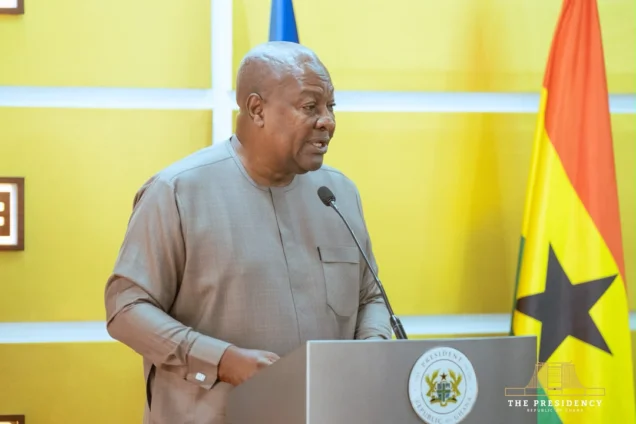
President John Dramani Mahama has officially ordered the immediate dissolution of the Board of Trustees for the National Cathedral of Ghana, a move that signals a significant shift in the government’s approach to the controversial and stalled project. In a directive issued through the Minister for Local Government, Chieftaincy and Religious Affairs, Mahama Ayariga, the trustees have been mandated to formally hand over the project site to the Ministry by October 31, 2026. This transition is intended to allow the administration to conduct a comprehensive assessment and determine the ultimate future of the site. While the Minister expressed gratitude for the board’s commitment to the Christian faith, the dissolution marks a clear departure from the previous administration’s focus on the monument.
Beyond the Cathedral, the government is intensifying its focus on core infrastructure and urban redevelopment. In Kumasi, Minister Ayariga announced that Phase II of the Kejetia Market redevelopment is set to resume in October 2026, supported by new funding arrangements between the Ministry of Finance and the Kumasi Metropolitan Assembly (KMA). To ensure the project’s sustainability, the government is introducing a market-based rental system designed to eliminate middleman exploitation and capture revenue directly for future expansions. Simultaneously, NDC National Chairman Johnson Asiedu Nketiah highlighted a massive GH₵4.12 billion investment in road infrastructure within the Bono Region, covering 252 kilometers. These projects, including the Sunyani Outer Ring Road, are framed as essential for enhancing agricultural transport and stimulating local economies.
However, the administration’s development agenda faces localized pushback and calls for greater accountability. In the Pusiga Constituency, the New Patriotic Party (NPP) has criticized the government for allegedly abandoning the Agenda 111 hospital project and local road improvements in favor of constructing a new 24-hour market. Meanwhile, in the Effia-Kwesimintsim Municipality, the civil society group Friends of the Nation (FoN) recently conducted a citizen-led monitoring exercise of projects funded by the District Assemblies Common Fund (DACF). Their findings highlighted critical gaps, such as a lack of disability-friendly access and inadequate public information signage, underscoring the need for improved transparency and compliance with legal standards in public works.
The government is also navigating complex resource and land disputes that threaten local livelihoods and investor confidence. In the Upper East Region, over a thousand workers at the Nalamtaaba Mining Enterprise in Gbani are appealing to the Minerals Commission to rescind a shutdown order that they claim favors external interests over local families. In the Greater Accra Region, tensions have flared at the La Pleasure Beach Resort, where management is resisting a National Security Council demolition directive by citing a pending court case over land ownership. These challenges, alongside grassroots efforts like Member of Parliament Abla Dzifa Gomashie’s distribution of 2,000 bags of fertilizer and streetlights in Ketu South, illustrate the balancing act the Mahama administration must perform between national policy shifts and the immediate economic security of Ghanaian citizens.
Related topic
NDC (National Democratic Congress): Latest News →

