••
President Mahama Champions 'Accra Reset Agenda' and Global Reparations at 81st UN General Assembly
•3 min read•11 sources
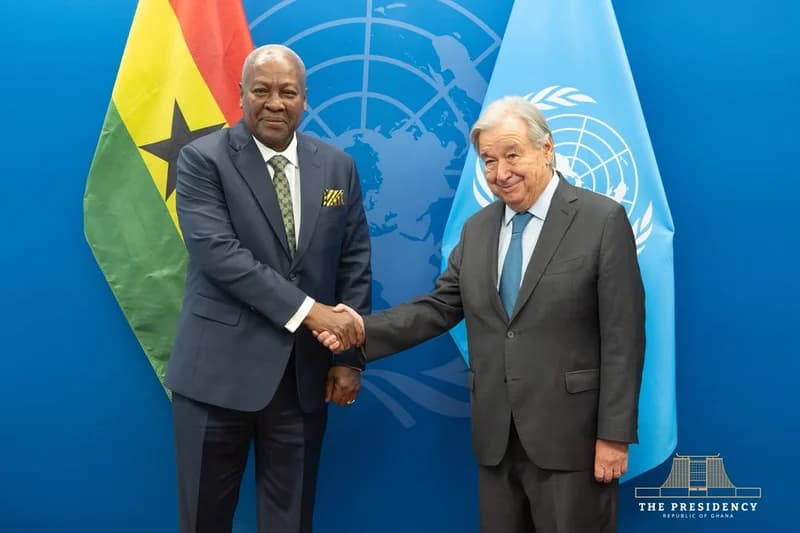
President John Dramani Mahama has asserted Ghana's and Africa's positions on the global stage during the 81st UN General Assembly in New York, centering his engagements on sovereignty, economic justice, and regional security. Through high-level bilateral talks with outgoing UN Secretary-General António Guterres and Chinese Vice President Han Zheng, the President championed the "Accra Reset Agenda," a framework aimed at achieving health and economic independence. Secretary-General Guterres commended President Mahama for his leadership on global reparations and his initiatives to reform international diplomacy, particularly as West Africa navigates complex peace and security challenges. President Mahama also utilized the global platform to demand a permanent seat for Africa on the UN Security Council, arguing that the continent must be treated as an equal partner rather than a recipient of charity. On the sidelines, the President met with Chinese Vice President Han Zheng to further strengthen Ghana-China relations, focusing on mutual cooperation and transformation in a shifting global landscape. During his address and various forums, the President offered a sharp critique of the "debt trap" stifling African development, noting that African nations often borrow at rates eight times higher than the global average. He highlighted that Africa loses approximately $90 billion annually to illicit financial flows—such as mis-invoicing by Western corporations—and $120 billion to debt servicing, far outstripping the Official Development Assistance received. To rectify these imbalances, he called for a comprehensive reform of the international financial architecture, specifically advocating for Africa's share in the International Monetary Fund (IMF) to increase from 4.5% to 10%. On regional stability, President Mahama traced the current terrorism surge in the Sahel to the destabilization of Libya following the US and French-led intervention. He warned that no nation, including Ghana, is immune to these threats and emphasized the need for an integrated African Union to bolster collective security. Furthermore, he defended Ghana's recent rejection of a proposed US health compact, labeling its conditions—which included sharing national medical records and allowing uninspected medical imports—as "humiliating" and an affront to sovereignty. This move underscores the "Accra Reset" initiative's goal of achieving self-sufficiency in medicine and vaccine production. The President concluded his engagements with a moral plea for cultural justice, demanding the return of African artefacts and human remains held in foreign nations. He insisted that these items are "not collectibles" and that their restitution is essential for restoring the dignity of African peoples. Domestically, President Mahama maintained a firm stance on accountability, issuing a stern warning to his own appointees during a meeting with Ghanaians in New York. He stated that the Economic and Organised Crime Office (EOCO) would be empowered to investigate corruption after they leave office, reinforcing his administration's commitment to transparency and the principle that accountability does not cease upon exiting government.
Related topic
John Mahama: Latest News & Updates →

