••
Interior Minister Muntaka Mohammed-Mubarak Outlines Digital Security Shift and Border Reforms to Enhance National Safety
•3 min read•9 sources
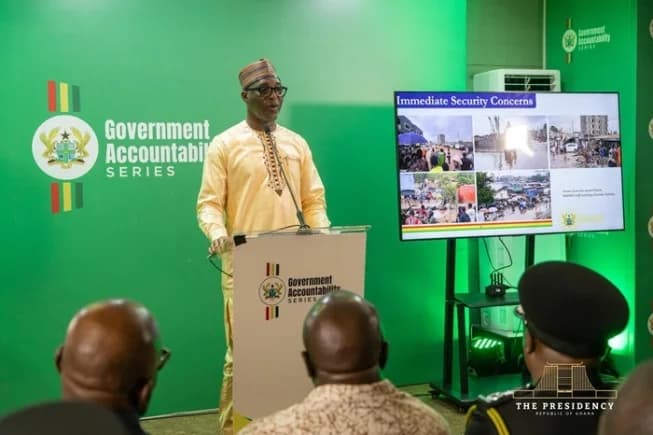
Ghana’s Minister for the Interior, Muntaka Mohammed-Mubarak, has announced a significant improvement in national security for 2026, stating that the country is notably safer than in previous years. Speaking during a Government Accountability Series, the Minister highlighted that active curfews across the country have been reduced from eleven to just three, reflecting a successful stabilization effort led by security agencies and supported by international partners like the Japanese Government. This progress is being anchored by a sweeping shift toward digitalization in law enforcement, aimed at reducing human interference and systemic corruption within the security apparatus.
Central to this modernization is the launch of 'TraffiTech-GH,' a technology-driven traffic enforcement system set to fully replace routine roadside checks by the Motor Traffic and Transport Department (MTTD) by September 2026. Utilizing a network of surveillance cameras, radar systems, and mobile monitoring devices, the system will automatically detect over 47 traffic violations, including the unauthorized use of sirens. Offenders will receive electronic notifications via SMS, with penalties tracked digitally to ensure revenue collection and accountability. Deputy Minister Ebenezer Okletey Terlabi emphasized that this transition is designed to curb the perceived corrupt practices associated with face-to-face traffic stops while significantly reducing road fatalities.
However, the Ministry faces persistent challenges at the nation’s borders, where a recent study by Professor Elijah Yendaw revealed that 58.2% of West African immigrant retailers enter Ghana through unapproved routes. The research cited extortion by officials, lack of travel documentation, and high costs at official points as primary drivers for these illegal crossings. To address this, Minister Mohammed-Mubarak reported that 4,201 foreign nationals have been removed since 2025. He acknowledged that currently only 12 of the 48 monitored border crossings possess biometric systems, prompting the government to procure drones, anti-ballistic cabins, and mobile surveillance technology to tighten oversight while maintaining ECOWAS protocols on free movement.
In a move to restore socio-economic normalcy in conflict-prone areas, the Ministry has also eased motorbike restrictions in Bawku, allowing movement between 6 a.m. and 6 p.m. while maintaining a 10 p.m. to 5 a.m. curfew. This easing follows positive security assessments and ongoing peace dialogues mediated by the National Peace Council. Simultaneously, Ghana has initiated bilateral talks with Burkina Faso and Côte d’Ivoire to establish Local Groups for Cross-Border Cooperation (LGCBCs). These diplomatic efforts aim to foster information sharing and community resilience along the borders, ensuring that the government’s technological security advancements are matched by strong regional partnerships.