••
President Mahama’s $10B 'New Economy' Agenda Moves Toward Implementation Amid World Bank Infrastructure and Reform Warnings
•3 min read•11 sources
Ghana’s Finance Minister, Dr. Cassiel Ato Forson, has officially commenced high-level consultations with the Ministry of Trade, Agribusiness, and Industry to activate President John Dramani Mahama’s $10 billion "New Economy" programme. This strategic initiative represents a pivot from economic stabilization toward a long-term transformative phase, heavily supported by the "Feed the Industries" policy. By directly linking large-scale agricultural production with domestic processing, the administration aims to revitalize factory output and reduce unemployment. Key measures include the removal of a 20% excise duty on locally produced fruit juices and the creation of commercial production clusters, which are expected to generate over 250,000 jobs and underpin the government’s 24-Hour Economy agenda.
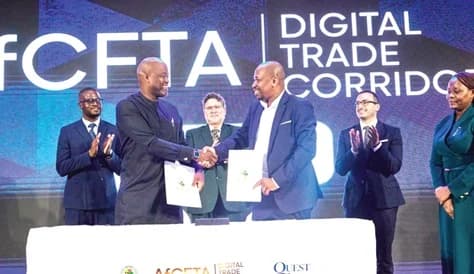
Industrial expansion is also taking shape in Northern Ghana with the development of the Northshore Apparel Hub in Savelugu. Presidential Adviser Augustus Obuadum Tanoh has identified this facility as a cornerstone for a light industrial park designed to boost export manufacturing and create inclusive employment opportunities. To support these exports, the government plans to establish an agricultural corridor and an air cargo hub at Tamale International Airport. On a continental level, the AfCFTA Secretariat and QUEST Ghana have signed a pact to launch the AfCFTA Digital Trade Corridor (ADTC). This digital platform, set to pilot in several nations, aims to streamline cross-border payments and commodity exchanges, positioning Africa to tap into a digital economy projected to reach $712 billion by 2035.
However, these growth prospects face significant headwinds from infrastructure gaps and fiscal risks. The World Bank’s 10th Ghana Economic Update has warned that poor road safety and infrastructure deficits cost the nation approximately US$4.55 billion annually, or 2.1% of GDP. Furthermore, the Bank cautioned that delays in critical reforms at the Ghana Gold Board, the energy sector, and COCOBOD could jeopardize recent debt sustainability gains. To mitigate these risks, the World Bank is advocating for a more robust fiscal risk management framework and greater accountability for state-owned enterprises to manage financial pressures before they destabilize public finances.
On the ground, local manufacturers are urging the government to address rising production costs to remain competitive. The Ghana Leather and Footwear Manufacturers Association has petitioned for lower import duties on raw materials, citing a struggle against cheap synthetic imports. Similarly, the cashew industry is grappling with a "processing gap," where Ghana processes less than 6% of its annual production compared to the aggressive expansion seen in Côte d’Ivoire. In response to these diverse economic needs, the government is also modernizing auxiliary sectors, such as providing industrial crushers to informal waste recyclers and launching the Ghana National Fire Service’s Automated Fire Compliance and Safety System (AFCAS) to digitize safety certifications.
Related topic
Ghana Fire Service Recruitment: Latest News Today →Live rates
Ghana gold price →

